
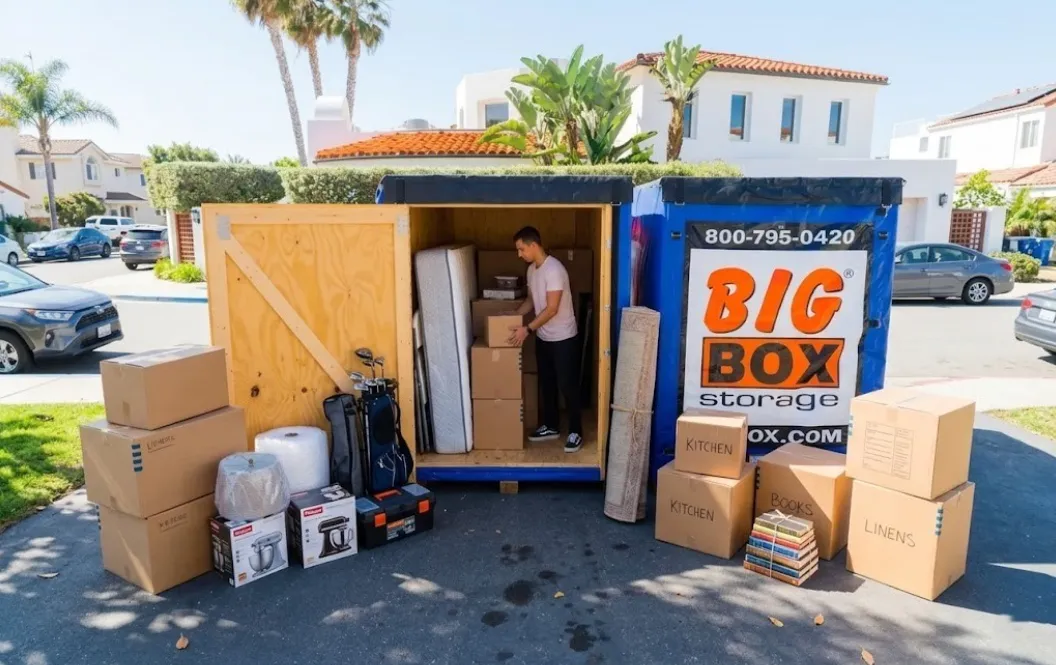
Quick Answer: Downsizing your home means more than moving – it means deciding what to do with everything that won’t fit in your new space. The most effective approach is a four-category framework: keep, store, donate, or sell. Portable storage units are especially useful during this transition, giving you a physical buffer to sort belongings without forcing premature decisions. Most people underestimate the time needed – start the process at least 90 days before your move date.
Most people think the hardest part of downsizing is finding the smaller home. It isn’t. The hardest part is standing in a living room full of furniture, knowing a third of it won’t fit – and having no plan for what happens next.
Here’s the thing most people miss: downsizing isn’t a decluttering project. It’s a logistics problem with an emotional layer on top. When you treat it that way, the whole thing becomes a lot more manageable.
Who’s Downsizing Right Now – and Why It Matters
Downsizing is no longer just a retirement milestone. According to the National Association of Realtors (NAR), roughly 73% of recent homebuyers had no children under 18 living at home – a signal that today’s housing market is increasingly shaped by smaller households. With the median homebuyer age rising into the late 50s, many of these buyers are older adults transitioning out of long-held family homes, often reevaluating how much space they actually need.
But that’s only part of the story. A second, often overlooked group is younger buyers who aren’t downsizing by choice – they’re right-sizing out of necessity. In high-cost markets like San Diego, where median home prices have climbed well around or above $800,000, many buyers in their 30s and 40s are opting for smaller condos simply because larger homes are out of reach. The result is the same logistical challenge – less space – but a very different emotional context.
Both groups arrive at the same question: you have a house full of belongings, but less room to keep them. What stays, and what goes?
The Four-Category Framework: Keep, Store, Donate, Sell
Stop sorting by room. Start sorting by decision.
Every item in your home belongs in one of four buckets, and the faster you apply this framework, the less overwhelmed you’ll feel.
Keep – Items that fit your new space physically and serve a real purpose in your new life. Be honest here. A 12-person dining table doesn’t belong in a two-bedroom condo, no matter how much you love it.
Store – Items you’re not ready to part with but don’t have room for yet. Seasonal equipment, family heirlooms, a second car, hobby gear for the garage you no longer have. This isn’t avoidance – it’s a legitimate category. Portable storage is purpose-built for exactly this gap. With Big Box Storage’s portable storage solutions, a unit gets dropped at your driveway, you load it on your timeline, and it moves when you do.
Donate – Functional items you don’t need. Goodwill, Habitat for Humanity ReStores, local shelters, Buy Nothing groups on Facebook. San Diego has strong donation infrastructure – use it.
Sell – Furniture, appliances, and collectibles with real resale value. Facebook Marketplace, Craigslist, and estate sale companies all work well for this. Don’t underestimate what a good mid-century credenza or solid wood bookcase will fetch.
The mistake most people make is defaulting everything to “keep” or “donate” while skipping the sell and store categories entirely. Those two categories are where you actually solve the problem.
Room-by-Room: Where to Start
Order matters. Start with the lowest emotional weight, build momentum, then tackle the hard rooms.
Garage and storage areas first. This is where the obvious discards live – duplicates, broken items, things you forgot you owned. Clear this first and you’ll generate immediate physical space to work in.
Guest bedroom second. Often doubles as a holding zone for stuff without a home. Sort it, don’t shuffle it.
Living room and dining room third. Furniture scale is the central challenge here. Measure your new space before you decide anything. A sofa that seats six will dominate a 400-square-foot living room.
Primary bedroom last. This carries the most personal weight. Give it the time it needs.
Furniture That Won’t Fit: Storage vs. Marketplace
This is where people get stuck. You have a piece you love – or inherited – but it simply doesn’t belong in a 1,200-square-foot condo.
The honest answer: if you’re not planning to use a piece within the next 12 months, a storage solution can give you the flexibility to hold onto it without overcrowding your current space. Storage boxes or units let you preserve items you value while giving yourself time to decide what truly fits your lifestyle – without the pressure to make a quick decision.
That said, there are legitimate reasons to store furniture during a transition. If you’re moving into a temporary space while a renovation finishes, or you’re bridging between selling and buying, keeping furniture in a portable storage unit for a few months makes financial sense. You’re not paying to store indefinitely – you’re buying time to make the right decision without pressure.

Why Portable Storage Works Better Than a Truck for Downsizing
Traditional moving truck logic assumes you know exactly what you’re taking on move day. Downsizing rarely works that way. You’re making decisions in real time, often discovering mid-pack that the bookcase won’t fit or the guest room bed needs to go.
Portable storage units flip this dynamic. You load at your own pace, over days or weeks. You can pull items back out if you change your mind. The unit travels to your new address – or stays in storage – based on what you actually need, not what you guessed you’d need in advance.
For downsizers in San Diego specifically, this matters because many transitions involve staging a home for sale while still living in it. A portable unit in the driveway can hold furniture and boxes that would otherwise clutter showings, without requiring you to rent a separate storage facility mid-move. If you want to compare portable storage with traditional self-storage to see which fits your situation, that breakdown covers costs, access, and logistics side by side.
The Downsizing Timeline: 90 Days Out to Move-In Day
90 days out: Apply the four-category framework room by room. Start donation runs. List high-value items for sale.
60 days out: Schedule your portable storage unit delivery. Begin packing non-essentials. Confirm furniture dimensions against your new floor plan.
30 days out: Finalize keep vs. store decisions. Complete sales. Clear donated items.
Move week: Load your portable unit. Stage the home for final walkthrough or photos. Let the unit do the heavy lifting – literally.
After move-in: Unpack keep items. Access your storage unit as needed. Make final sell or donate decisions for stored items within 6–12 months.
Final Thoughts
The real secret to downsizing well isn’t sentimentality management or ruthless minimalism. It’s giving yourself enough time and enough physical space to make decisions without panic. A portable storage unit isn’t a crutch – it’s the tool that makes thoughtful decisions possible.
Start earlier than you think you need to. Sort by decision category, not by room. And remember: the goal isn’t an empty house. It’s a new home with exactly what you need in it.